Thursday, May 19, 2011

Fox Tossing

Fox tossing would take place in an arena, usually either created by setting up a circle of canvas screens in the open or by using the courtyard of a castle or palace. Two people would stand six to seven and a half metres (20 to 25 feet) apart, holding the ends of a webbed or cord sling which was laid flat on the ground. An animal such as a fox would then be released from a cage or trap and driven through the arena, across the sling. As it crossed the sling the tossers pulled hard on the ends, throwing the animal high into the air. The highest throw would win the contest; expert tossers could achieve throws of as high as 7.5 m (24 ft). On occasion, several slings were laid in parallel, so that the animal would have to run the gauntlet of several teams of tossers.

The result was often fatal for the tossed animal. Augustus the Strong, the Elector of Saxony, held a famous tossing contest in Dresden at which 647 foxes, 533 hares, 34 badgers and 21 wildcats were tossed and killed. Augustus himself participated, reportedly demonstrating his strength by holding the end of his sling by just one finger, with two of the strongest men in his court on the other end. Other rulers also participated in the sport. The Swedish envoy Esaias Pufendorf, witnessing a fox-tossing contest held in Vienna in March 1672, noted in his diary his surprise at seeing the Holy Roman Emperor Leopold I enthusiastically joining the court dwarfs and boys in clubbing to death the injured animals.

The tossing of foxes and other animals was not without risk to the participants, as it was not uncommon for the terrified animals to turn on the tossers. Wildcats were particularly troublesome; as one writer remarked, they "do not give a pleasing kind of sport, for if they cannot bury their claws and teeth in the faces or legs of the tossers, they cling to the tossing-slings for dear life, and it is next to impossible to give one of these animals a skilful toss".

From: http://en.wikipedia.org/wiki/Fox_tossing


Tuesday, May 10, 2011

Witold Pilecki

Witold Pilecki was a soldier of the Second Polish Republic, the founder of the Secret Polish Army (Tajna Armia Polska) resistance group and a member of the Home Army (Armia Krajowa). As the author of the Witold`s report, the first intelligence report on Auschwitz concentration camp, Pilecki's operation enabled the Polish government-in-exile to convince the Allies that the Holocaust was taking place.

In 1940, Pilecki presented to his superiors a plan to enter Germany's Auschwitz concentration camp at Oświęcim (the Polish name of the locality), gather intelligence on the camp from the inside, and organize inmate resistance. Until then, little had been known about the Germans' running of the camp, and it was thought to be an internment camp or large prison rather than a death camp. His superiors approved the plan and provided him a false identity card in the name of "Tomasz Serafiński." On September 19, 1940, he deliberately went out during a Warsaw street roundup (łapanka), and was caught by the Germans along with some 2,000 innocent civilians (among them, Władysław Bartoszewski). After two days of torture in Wehrmacht barracks, he was sent to Auschwitz. Pilecki was tattooed on his forearm with the number 4859.

At Auschwitz, while surviving pneumonia, Pilecki organized an underground Union of Military Organizations (Związek Organizacji Wojskowej, ZOW). ZOW provided priceless information on the camp. From October 1940, ZOW sent reports to Warsaw, and beginning March 1941, Pilecki's reports were being forwarded via the Polish resistance to the British government in London. These reports were a principal source of intelligence on Auschwitz for the Western Allies. Pilecki hoped that either the Allies would drop arms or troops into the camp, or the Home Army would organize an assault on it from outside. Such plans, however, were all judged impossible to carry out. Meanwhile the Gestapo redoubled its efforts to ferret out ZOW members, succeeding in killing many of them. Pilecki decided to break out of the camp, with the hope of personally convincing Home Army leaders that a rescue attempt was a valid option. When he was assigned to a night shift at a camp bakery outside the fence, he and two comrades overpowered a guard, cut the phone line and escaped on the night of April 26/27, 1943, taking along documents stolen from the Germans.

When the Warsaw Uprising broke out on August 1, 1944, Pilecki volunteered. His forces held a fortified area called the "Great Bastion of Warsaw". It was one of the most outlying partisan redoubts and caused considerable difficulties for German supply lines. The bastion held for two weeks in the face of constant attacks by German infantry and armor. On the capitulation of the uprising, Pilecki hid some weapons in a private apartment and went into captivity. He spent the rest of the war in German prisoner-of-war camps

On July 9, 1945, Pilecki was liberated from the POW camp, and returned to Poland, where he proceeded to organize his intelligence network. In the spring of 1946, however, the Polish government-in-exile decided that the postwar political situation afforded no hope of Poland's liberation and ordered all partisans still in the forests (cursed soldiers) either to return to their normal civilian lives or to escape to the West. In July 1946, Pilecki was informed that his cover was blown and ordered to leave; he declined. In April 1947, he began collecting evidence on Soviet atrocities and on the prosecution of Poles (mostly members of the Home Army and the 2nd Polish Corps) and their executions or imprisonment in Soviet gulags.

On May 8, 1947, he was arrested by the Ministry of Public Security. Prior to trial, he was repeatedly tortured. The investigation on Pilecki’s activities was supervised by Colonel Roman Romkowski. He was interrogated by Col. Józef Różański, and lieutenants: S. Łyszkowski, W. Krawczyński, J. Kroszel, T. Słowianek, Eugeniusz Chimczak, and S. Alaborski – men who were especially famous for their savagery. But Pilecki sought to protect other prisoners and revealed nosensitive information.

On March 3, 1948, a show trial took place. Testimony against him was presented by a future Polish prime minister, Józef Cyrankiewicz, himself an Auschwitz survivor. On May 15, with three of his comrades, he was sentenced to death. Ten days later, on May 25, 1948, Pilecki was executed at the Warsaw Mokotów Prison on ulica Rakowiecka street.

In 1995, he received posthumously the Order of Polonia Restituta. In 2006, he received the Order of the White Eagle, the highest Polish decoration. His place of burial has never been found. He is thought to have been buried in an unmarked grave near Warsaw's Powązki Cemetery's garbage dump.

From: http://en.wikipedia.org/wiki/Witold_Pilecki

Wednesday, May 4, 2011

Amorphophallus titanum

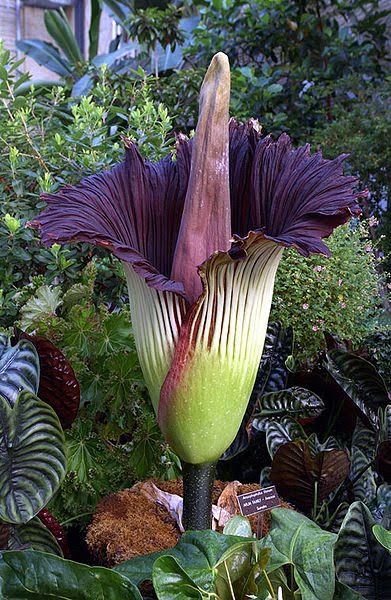
The titan arum or Amorphophallus titanum (from Ancient Greek amorphos, "without form, misshapen" + phallos, "phallus", and titan, "giant") is a flowering plant with the largest unbranched inflorescence (flower) in the world. The titan arum's inflorescence can reach over 3 metres (10 ft) in height. The "fragrance" of the inflorescence resembles rotting meat, attracting carrion-eating beetles and Flesh Flies that pollinate it. Due to its odor, the titan arum is characterized as a carrion flower, and is also known as the "corpse flower", or "corpse plant" The flower's deep red color and texture contribute to the illusion that the spathe is a piece of meat. During bloom, the tip of the spadix is approximately human body temperature, which helps the perfume volatilize; this heat is also believed to assist in the illusion that attracts carcass-eating insects.

Both male and female flowers grow in the same inflorescence. The female flowers open first, then a day or two following, the male flowers open. This prevents the flower from self-pollinating. After the flower dies back, a single leaf, which reaches the size of a small tree, grows from the underground corm (underground plant stem). The leaf can reach up to 20 ft tall and 16 ft across. Each year, the old leaf dies and a new one grows in its place. When the corm has stored enough energy, it becomes dormant for about 4 months. Then, the process repeats. The corm is the largest known, weighing around 50 kilograms (110 lb). When a specimen at the Princess of Wales Conservatory, Kew Gardens, was repotted after its dormant period, the weight was recorded as 91 kilograms (200 lb).

The popular name 'Titan arum' was invented by the broadcaster and naturalist Sir David Attenborough, for his BBC series 'The Private Life of Plants,' in which the flowering and pollination of the plant were filmed for the first time. Attenborough felt that constantly referring to the plant as Amorphophallus on a popular TV documentary would be inappropriate.

From: http://en.wikipedia.org/wiki/Amorphophallus_titanum

Tuesday, April 26, 2011

Fregoli Delusion / Capgras Delusion

Fregoli Delusion

The Fregoli delusion or the delusion of doubles is a rare disorder in which a person holds a delusional belief that different people are in fact a single person who changes appearance or is in disguise. The syndrome may be related to a brain lesion, and is often of a paranoid nature with the delusional person believing themselves persecuted by the person they believe is in disguise. The opposite, Fregoli syndrome, is the belief that people you know have been disguised to appear as strangers.

The condition is named after the Italian actor Leopoldo Fregoli who was renowned for his ability to make quick changes of appearance during his stage act.


Capgras Delusion

The Capgras delusion theory (or Capgras syndrome) is a disorder in which a person holds a delusion that a friend, spouse, parent, or other close family member has been replaced by an identical-looking impostor. The Capgras delusion is classified as a delusional misidentification syndrome, a class of delusional beliefs that involves the misidentification of people, places, or objects.

From: http://en.wikipedia.org/wiki/Fregoli_delusion

Sunday, April 24, 2011

Punt Gun

A punt gun is a type of extremely large shotgun used in the 19th and early 20th centuries for shooting large numbers of waterfowl for commercial harvesting operations and private sport. Punt guns were usually custom-designed and so varied widely, but could have bore diameters exceeding 2 inches and fire over a pound of shot at a time. A single shot could kill over 50 waterfowl resting on the water's surface. They were too big to hold and the recoil so large that they were mounted directly on the punts used for hunting, hence their name. Hunters would maneuver their punts quietly into line and range of the flock using poles or oars to avoid startling them. Generally the gun was fixed to the punt; thus the hunter would maneuver the entire boat in order to aim the gun. The guns were sufficiently powerful, and the punts themselves sufficiently small, that firing the gun often propelled the punt backwards several inches or more. To improve efficiency, hunters could work in fleets of up to around ten punts.


In the United States, this practice depleted stocks of wild waterfowl and by the 1860s most states had banned the practice. The Lacey Act of 1900 banned the transport of wild game across state lines, and the practice of market hunting was outlawed by a series of federal laws in 1918. In the United Kingdom, a 1995 survey showed fewer than 50 active punt guns still in use. UK law limits punt guns to a bore diameter of 1.75 inches.

From: http://en.wikipedia.org/wiki/Punt_gun

Thursday, April 14, 2011

Saparmyrat Ataýewiç Nyýazow

Saparmurat Atayevich Niyazov was a Turkmen politician who served as President (later President for Life) of Turkmenistan from 2 November 1990 until his death in 2006. Turkmen media referred to him using the title "His Excellency Saparmurat Türkmenbaşy, President of Turkmenistan and Chairman of the Cabinet of Ministers". His self-given title Türkmenbaşy


Foreign media criticized him as one of the world's most totalitarian and repressive dictators, highlighting his reputation of imposing his personal eccentricities upon the country, which extended to renaming months after members of his family, and recoining the Turkmen word for bread by the name of his mother.


Niyazov set about separating Turkmenistan from the dying Soviet Union. The Supreme Soviet declared Turkmenistan independent and elected Niyazov as the country's first president on October 27. On June 21, 1992, Niyazov was elected as the country's first popularly elected president; he was the only candidate. A year later, he declared himself "Türkmenbaşy," or "Leader of all Turkmen." In 1994 a plebiscite extended Niyazov's term to 2002 so he could oversee a 10-year development plan. The official results showed that 99.9% of voters approved this proposal. On December 28, 1999, Parliament declared Niyazov President for Life; parliamentary elections had been held a few weeks earlier in which all candidates were hand-picked by the president.


Niyazov made a personal attempt to create a cultural background for the new state of Turkmenistan by writing and promoting the Ruhnama, an autobiography meant to guide the people of Turkmenistan with his ideas and promote native culture (and by extension prohibiting foreign culture). He also took part in creating new holidays with a specific Turkmen nature and introduced a new Turkmen alphabet to replace Russian Cyrillic.


He renamed the town of Krasnovodsk "Turkmenbashi" after himself, and renamed schools, airports and even a meteorite after himself and members of his family.


The Neutrality Arch in Ashgabat featured a gold-plated statue of Niyazov which rotated 360 degrees every 24 hours so as to always face the sun.


September was renamed Ruhnama in honour of the book written by Niyazov (which he finished writing on 19 September 2001).


In February 2005 all hospitals outside Aşgabat were ordered shut, with the reasoning that the sick should come to the capital for treatment. According to the paper Neitralniy Turkmenistan physicians were ordered to swear an oath to the President, replacing the Hippocratic Oath.


All libraries outside of the capital were also closed, as Niyazov believed that the only books that most Turkmen needed to read were the Koran and his Ruhnama.


Niyazov banished dogs from the capital Ashgabat because of their "unappealing odor."


Niyazov requested that a "palace of ice" be built near the capital, even though Turkmenistan is a desert country with a hot and arid climate. The palace was built in 2008 and located near the new Turkmen State Medical University.


In February 2004 he decreed that men should no longer wear long hair or beards.


He also banned news reporters and anchors from wearing make-up on television, apparently because he believed Turkmen women were already beautiful enough without make-up.


Gold teeth were outlawed in Turkmenistan after Niyazov suggested that the populace chew on bones to strengthen their teeth and lessen the rate at which they fall out. He said: "I watched young dogs when I was young. They were given bones to gnaw to strengthen their teeth. Those of you whose teeth have fallen out did not chew on bones. This is my advice..."


From: http://en.wikipedia.org/wiki/Saparmurat_Niyazov


Tuesday, April 5, 2011

Edwin Booth

Edwin Thomas Booth (November 13, 1833 – June 7, 1893) was a famous 19th century American actor who toured throughout America and the major capitals of Europe, performing Shakespearean plays. In 1869 he founded Booth's Theatre in New York, a spectacular theatre that was quite modern for its time. Some theatrical historians consider him the greatest American actor, and the greatest Hamlet, of the 19th century. However, he is today often remembered as the brother of John Wilkes Booth, the man who assassinated President Abraham Lincoln.


Before his brother assassinated Lincoln, Edwin had appeared with his two brothers John Wilkes and Junius Brutus Booth, Jr., in Julius Caesar in 1864. John Wilkes played Marc Antony, Edwin played Brutus, and Junius played Cassius. It was a benefit performance, and the only time that the three brothers would appear together on the same stage. The funds were used to erect a statue of William Shakespeare that still stands in Central Park just south of the Promenade.


In an interesting coincidence, Edwin Booth saved Abraham Lincoln's son, Robert, from serious injury or even death. The incident occurred on a train platform in Jersey City, New Jersey. The exact date of the incident is uncertain, but it is believed to have taken place in late 1864 or early 1865, shortly before Edwin's brother, John Wilkes Booth, assassinated President Lincoln.


Robert Lincoln recalled the incident in a 1909 letter to Richard Watson Gilder, editor of The Century Magazine.


The incident occurred while a group of passengers were late at night purchasing their sleeping car places from the conductor who stood on the station platform at the entrance of the car. The platform was about the height of the car floor, and there was of course a narrow space between the platform and the car body. There was some crowding, and I happened to be pressed by it against the car body while waiting my turn. In this situation the train began to move, and by the motion I was twisted off my feet, and had dropped somewhat, with feet downward, into the open space, and was personally helpless, when my coat collar was vigorously seized and I was quickly pulled up and out to a secure footing on the platform. Upon turning to thank my rescuer I saw it was Edwin Booth, whose face was of course well known to me, and I expressed my gratitude to him, and in doing so, called him by name.


Booth did not know the identity of the man whose life he had saved until some months later, when he received a letter from a friend, Colonel Adam Badeau, who was an officer on the staff of General Ulysses S. Grant. Badeau had heard the story from Robert Lincoln, who had since joined the Union Army and was also serving on Grant's staff. In the letter, Badeau gave his compliments to Booth for the heroic deed. The fact that he had saved the life of Abraham Lincoln's son was said to have been of some comfort to Edwin Booth following his brother's assassination of the president.


After John Wilkes Booth's assassination of President Lincoln in April 1865, the infamy associated with the Booth name forced Edwin Booth to abandon the stage for many months. Edwin, who had been feuding with John Wilkes before the assassination, disowned him afterward, refusing to have John's name spoken in his house.

From: http://en.wikipedia.org/wiki/Edwin_Booth