Sunday, May 16, 2010

Vladimir Petrovich Demikhov

Vladimir Petrovich Demikhov was a Soviet scientist and organ transplant pioneer, who did several transplantations in the 1930s and 1950s, such as the transplantation of a heart into an animal and a lung-heart replacement in an animal. He is also well-known for his transplantation of the heads of dogs. He conducted his dog head transplants during the 1950s, resulting in two-headed dogs.

The first head transplant was actually done by Professor A. G. Konevskiy of the Operative Surgery and Topographical Anatomy Department of Volgograd State Medical University. The head transplant wasn't planned. Konevskiy had planned an experimental heart transplant but the puppy was involved in an automobile accident. Not wanting to "waste the sterilized operating table", the surgeon proceeded with the head transplant.

Demikhov died in obscurity in 1998, but was awarded the Order "For Services Rendered to the Country", Third Class, shortly before his death.

From: http://en.wikipedia.org/wiki/Vladimir_Demikhov

Saturday, May 8, 2010

Emu War

The "Emu War" was a nuisance wildlife management operation undertaken in Australia over the latter part of 1932 to address public concern over the number of emus said to be running amok in the Campion district of Western Australia. The attempts to curb the population of emus, a large flightless bird indigenous to Australia, employed soldiers armed with machine guns – leading the media to adopt the satirical name "Emu War" when referring to the incident.

Subsequent to the cessation of hostilities after World War I, large numbers of ex-soldiers from Australia, along with a number of British veterans, took up farming within Western Australia. Having served in World War One, the soldier-settlers were well aware of the effectiveness of machine guns, and they requested their deployment. The Minister of Defence readily agreed, although with conditions attached: the guns had to be used by military personnel, the transport of the troops had to be paid for by the Western Australian government, and the farmers would provide food, accommodation, and payment for the ammunition. Pearce agreed on the grounds that the birds would make good target practice.

The "war" was conducted under the command of Major G.P.W. Meredith. In his report he claimed 986 kills with 9,860 rounds, at a rate of exactly 10 rounds per confirmed kill. In addition, Meredith claimed 2,500 wounded birds had died as a result of the injuries that they had sustained.

In spite of the problems encountered with the cull, the farmers of the region once again requested military assistance in 1934, 1943 and 1948, only to be turned down by the government. Instead, the bounty system that had been instigated in 1923 was continued, and this proved to be effective: 57,034 bounties were claimed over a six month period in 1934.

From: http://en.wikipedia.org/wiki/Emu_War


Sunday, May 2, 2010

Tsutomu Yamaguchi

A resident of Nagasaki, Yamaguchi was in Hiroshima on business for his employer Mitsubishi when the city was bombed on 6 August 1945. The following day he returned to Nagasaki and, despite his wounds, returned to work on 9 August, the day of the second atomic bombing.

Hiroshima bombing
Yamaguchi lived and worked in Nagasaki, but in the summer of 1945 he went to Hiroshima for a three month business trip. On 6 August he was preparing to leave the city with two colleagues, Akira Iwanaga and Kuniyoshi Sato, and was on his way to the station when he realized he had forgotten his hanko, and returned to his workplace to get it. At 8:15 he was walking back towards the docks when the American bomber Enola Gay dropped the Little Boy atomic bomb near the centre of the city, only 3 km away. Yamaguchi recalls seeing the bomber and two small parachutes, before there was "a great flash in the sky, and I was blown over" The explosion ruptured his eardrums, blinded him temporarily, and left him with serious burns over the left side of the top half of his body. After recovering he crawled to a shelter, and having rested he set out to find his colleagues. They had also survived and together they spent the night in an air-raid shelter before returning to Nagasaki the following day. In Nagasaki he received treatment for his wounds and, despite being heavily bandaged, he reported for work on 9 August.

Nagasaki bombing
At 11 am on August 9, Yamaguchi was describing the blast in Hiroshima to his supervisor, when the American bomber Bocks Car dropped the Fat Man atomic bomb onto Nagasaki. His workplace again put him 3 km from ground zero, but this time he was unhurt by the explosion.

From: http://en.wikipedia.org/wiki/Tsutomu_Yamaguchi


Sunday, April 25, 2010

Defenestration

Defenestration is the act of throwing someone or something out of a window. The term "defenestration" was coined around the time of an incident in Prague Castle in the year 1618. The word comes from the Latin de- (from) and fenestra (window or opening).

The act carries the connotation of forcibly or peremptorily removing an adversary, and is sometimes used in just that sense it also suggests breaking the windows in the process. Although defenestrations can be fatal due to the height of the window through which a person is thrown or throws oneself, or due to lacerations from broken glass, the act of defenestration need not carry the intent or result of death.

The term originates from two incidents in history, both occurring in Prague. In 1419 seven town officials were thrown from the Town Hall, precipitating the Hussite War. In 1618 two Imperial governors and their secretary were thrown from Prague Castle, sparking the Thirty Years War. These incidents, particularly that of 1618, were referred to as the Defenestration of Prague and gave rise to the term and the concept.

From: http://en.wikipedia.org/wiki/Defenestration


Sunday, April 18, 2010

Dancing Mania

Dancing mania was a social phenomenon that occurred primarily in mainland Europe between the 14th and 18th centuries; it involved groups of people, sometimes thousands at a time, who danced uncontrollably and bizarrely. Men, women, and children would dance through the streets of towns or cities, sometimes foaming at the mouth until they collapsed from fatigue.

One of the first major outbreaks was in Aachen, Germany, on June 24, 1374; the populace danced wildly through the streets, screaming of visions and hallucinations, and even continued to writhe and twist after they were too exhausted to stand. Having occurred to thousands of people across several centuries, dancing mania was not a local event.

Although no real consensus exists as to what caused the mania, some cases, may have ergot poisoning, known in the Middle Ages as "St. Anthony's Fire". It is caused by eating rye infected with Claviceps purpurea, a small fungus that contains toxic and psychoactive chemicals, including lysergic acid and ergotamine (used in modern times as a precursor in the synthesis of LSD). However, ergotism causes its victims to have visions, not to dance. The fact that large numbers of people were afflicted in mass outbursts that lasted for a few days or weeks at a time suggests that the cause of the dancing-mania phenomenon is more likely to be social than physical

From: http://en.wikipedia.org/wiki/Dancing_mania

Sunday, April 11, 2010

Tsar Tank

The Tsar Tank was an unusual Russian armored vehicle developed in 1916–1917.

The project was scrapped after initial tests deemed the vehicle to be underpowered and vulnerable to artillery fire.

It differed from modern tanks in that it didn't use caterpillar tracks—rather, it used a tricycle design. The two front spoked wheels were nearly 9 meters (27 feet) in diameter; the back wheel was smaller, only 1.5 meters (5 feet) high, triple wheel, to ensure maneuverability. The upper cannon turret reached nearly 8 meters high. The hull was 12 meters wide with two more cannons in the sponsons. Additional weapons were also planned under the belly. Each wheel was powered by a 250hp Sunbeam engine.

The huge wheels were intended to cross significant obstacles. However, due to miscalculations of the weight, the back wheel was prone to be stuck in soft ground and ditches, and the front wheels were sometimes insufficient to pull it out. This led to a fiasco of tests before the high commission in August 1915. The tank remained in the location where it was tested, some 60 kilometers from Moscow until 1923 when it was finally taken apart for scrap.

From: http://en.wikipedia.org/wiki/Tsar_Tank


Sunday, April 4, 2010

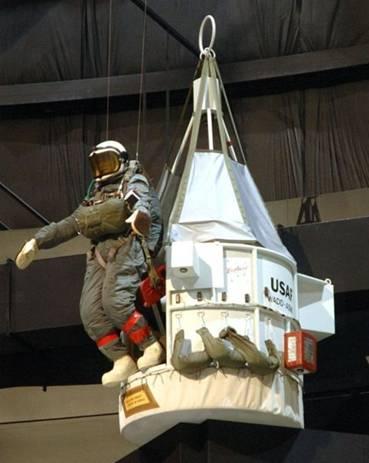
Project Excelsior

Project Excelsior was a series of high-altitude parachute jumps made by Colonel (then Captain) Joseph Kittinger of the United States Air Force in 1959 and 1960 to test the Beaupre multi-stage parachute system. In one of these jumps Kittinger set world records for the highest parachute jump, the longest parachute drogue fall and the fastest speed by a human through the atmosphere, all of which still stand.

To test the parachute system, staff at Wright Field built a 200 ft (61 m) high helium balloon with a capacity of nearly 3 million cubic feet (85,000 m³) that could lift an open gondola and test pilot into the stratosphere.

The third and final test, Excelsior III, was made on August 16, 1960. During the ascent, the pressure seal in Kittinger's right glove failed, and he began to experience severe pain in his right hand. (See Effects of vacuum on humans.) He decided not to inform the ground crew about this, in case they should decide to abort the test. Despite temporarily losing the use of his right hand, he continued with the ascent, climbing to an altitude of 31,333 m (102,800 ft).[2] The ascent took one hour and 31 minutes and broke the previous manned balloon altitude record. Kittinger stayed at peak altitude for 12 minutes, waiting for the balloon to drift over the landing target area. He then stepped out of the gondola to begin his descent. Kittinger fell for 4 minutes and 36 seconds, setting a still-standing world record for the longest parachute free-fall. During the descent, Kittinger experienced temperatures as low as −94 °F (−70 °C). In the free-fall stage, he reached a top speed of 988 km/h (614 mph).

From: http://en.wikipedia.org/wiki/Project_Excelsior